Upper West Region · near Wa
Nakore Mosque
A small mosque of earth and timber a few kilometres outside Wa, in the same building tradition as Larabanga and quite possibly as old. Almost nobody goes. That is the whole point of it.
- RegionUpper West
- Regional capitalWa
- From Waapprox. 15 – 20 min
- StyleSudanic
- MaterialEarth and timber
- Still in useYes — a working mosque
What it is
Nakore sits a short drive south-west of Wa, and its mosque belongs to a family of buildings that has a better claim to be Ghana's oldest surviving architecture than anything on the coast: the earth mosques of the north, built in the Sudanic-Sahelian tradition that runs from Djenné in Mali across the Sahel and down into Burkina Faso, Côte d'Ivoire and northern Ghana.
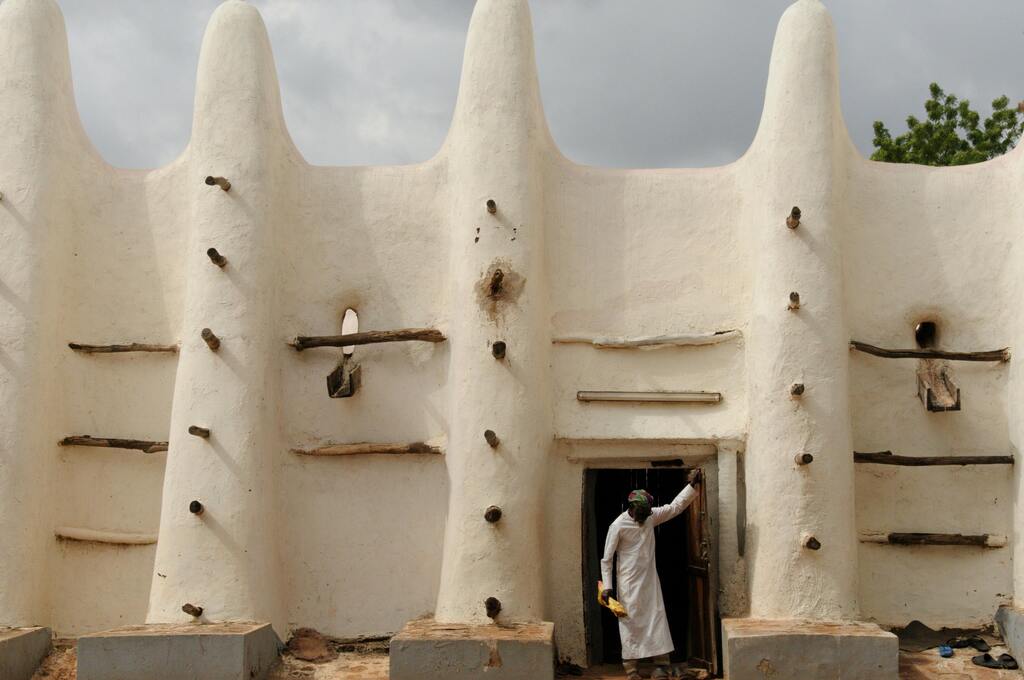
It is rectangular, its roof carried on internal timber posts rather than on the walls. Two pyramidal towers rise from it — the minaret and the mihrab, the latter marking the direction of Mecca. Around the outside run heavy buttresses whose pinnacles project above the parapet, and out of the walls stick the ends of horizontal timbers.
Those timbers are the whole story of the building. They are structural, and they are also the permanent scaffolding. When the mud coat is renewed after the rains, the community climbs on them. A building of earth survives only because people come back to it every single year — which means Nakore has stood because generations in this village decided, over and over, that it should.
How Islam reached here
Islam arrived in West Africa with trade, not with armies. It reached Egypt in the seventh century, spread west along the North African coast, and crossed the Sahara from the eighth and ninth centuries onward along the caravan routes that carried gold, salt and enslaved people between the Sahel and the Mediterranean.
Mande merchants, scholars and clerics travelled those routes. At the market towns and resting places along them, communities converted, and where there were Muslims there were mosques. Wa and its surroundings became one of those centres, with a Muslim scholarly tradition that long predates any European presence in what is now Ghana.
By the seventeenth century, Islamic settlement in this area was firmly established, and the surviving earth mosques of the north belong to the centuries that follow.
What is not known
Nobody can give you a reliable construction date for Nakore. The figures that circulate for Ghana's northern mosques are traditional rather than established — no archaeological dating has settled any of them, and Nakore has received far less scholarly attention than Larabanga. This page will not invent a year.
What can be said
It is an authentic example of its type, in continuous religious use, maintained by its community. That is a stronger claim than a number, and it is verifiable by anyone who stands in front of it.
Why go here rather than Larabanga
Larabanga is the famous one. It sits on the road to Mole National Park, it is called the Mecca of West Africa, it has appeared on the World Monuments Fund's list of endangered sites, and every visitor to the north passes it. It also has guides, fees, a queue at busy times and a well-rehearsed routine.
Nakore has none of that. It is the same architecture, in a village where a visitor is unusual. There is no crowd in your photograph, nobody waiting behind you, and the person who shows you around is likely to be somebody who prays there.
If you are in the Upper West at all, this is the better building to spend an hour with. Larabanga is the one you have seen pictures of. Nakore is the one you will remember.
It is a working mosque
This is not a monument with a custodian. On Fridays and at religious festivals the community gathers here for prayer and Qur'anic readings, and it serves as a place of pilgrimage for Muslims in the region.
Private readings are arranged through the chief imam for people facing serious difficulty or seeking protection before a journey or a venture. In return the imam will normally ask for the sacrifice of a cow or other donations to the community — which is, in practice, part of how the building is kept standing.
That matters more than it sounds. Of the old earth mosques of the Waala kingdom, Nakore is the one that never stopped being used and cared for. The other two were not so lucky: Wechiau was abandoned in the 1990s and Dondoli fell into ruin, until both were taken into a restoration project in 2023–24.
Visiting
- Ask before you do anything. Before entering the compound, before photographing the building, and certainly before photographing any person. Accept a refusal without argument.
- Access to the interior is usually restricted to Muslims, as it is at Larabanga. Expect to see the exterior and to have it explained to you.
- Do not arrive at prayer time expecting a tour. Mid-morning is a safer bet.
- Dress modestly — covered shoulders and legs, for men as well as women.
- Bring cash in small notes. There is no ticket office and no fixed fee. A contribution to the mosque, and something for whoever shows you around, is the right thing to do and the only income the site produces.
- Do not climb on the buttresses or the projecting timbers. They are the structure.
- Allow an hour. Less and you are ticking a box.
Getting there
From Wa
Fifteen to twenty minutes by car or by local transport. The road is passable most of the year but can be rough in the rainy season, roughly May to October. A hired taxi for the round trip with waiting time is the simplest arrangement; agree the price and the wait before setting off.
Arranging a guide
Tours can usually be arranged in Wa through the regional tourism office or a cultural centre. Going with someone from Wa who knows the village saves you the awkward arrival and makes the visit better for everyone.
From southern Ghana
Wa has an airstrip with occasional flights from Accra International Airport; schedules change and should be confirmed rather than assumed. Current routes are on ghanaflights.info. By road, Wa is a long day from Kumasi and a very long one from Accra.
Where to stay
Wa itself. There is nothing in Nakore, and that is part of its appeal. Options for the region are on ghanahotels.biz.
Combine it with
- Dondoli Mosque — a nineteenth-century mosque in Wa itself, within walking distance of the Wa Naa's Palace, and the easiest of the group to reach. Long a ruin, taken into a restoration project in 2023–24.
- Wechiau Mosque — in the same district as the Wechiau Community Hippo Sanctuary on the Black Volta, which makes for a natural two-in-one day. Abandoned in the 1990s and restored in earth in early 2024.
- Gbele Resource Reserve — the Upper West's protected area, quiet and rarely visited.
- Larabanga Mosque — the famous one, on the way to Mole if you are heading east.
- Bole, Banda Nkwanta and Maluwe — the old Gonja mosques of the Savannah Region, and the site of the lost mosque at Dakrupe.
- Wuriyanga — the only Djenné-type mosque in Ghana, near Garu in the far north-east.
- All nine ancient mosques of Ghana — the full status report, region by region.
- Bolgatanga — across in the Upper East, for crafts, and further on for Paga and Pikworo.
- All sixteen regions and their capitals
Guided tours in Ghana
For Nakore itself, arrange locally in Wa — no international operator runs this. For the wider country, the tours below are bookable in advance.
The honest verdict
Nakore will take you an hour and it will not entertain you. There is no visitor centre, no interpretation, no shop, and quite possibly nobody expecting you. What there is, is a building made of the ground it stands on, kept upright for centuries by the people who pray in it, in a style that most of the world associates with Mali and has no idea exists in Ghana.
Go if you are in the Upper West. Go with a guide from Wa, go quietly, contribute something, and understand that the reason it is still there has nothing to do with tourism and never did.