Around forty European forts once stood along 500 kilometres of this coast — the densest
concentration of military architecture anywhere outside Europe. They were built to hold
gold. They ended up holding people. This is the complete guide, fort by fort — with a page
for every one, and a dedicated site for most.
Read this before you go
The forts of Ghana are inscribed together on the UNESCO World Heritage List, and the
listing is unusual: it covers not one monument but a chain of them, built between 1482 and
the nineteenth century by the Portuguese, Dutch, British, Danish, Swedish and Brandenburg
Prussians. Some changed hands five or six times.
They were not built for the slave trade. They were built for gold — this
was the Gold Coast, and Elmina exists because Portugal wanted a fortified warehouse for it.
The dungeons came later, when the Atlantic trade in people became more profitable than the
trade in metal. That sequence matters, because it explains the architecture: rooms designed
for storage, repurposed for human beings, with no provision made for them at all.
Two of these sites — Cape Coast and Elmina — receive most of the world's attention and are
properly presented. The rest range from partially restored to actively
collapsing. Some are private homes, one is a prison, several are ruins in the surf,
and at least one has gone into the sea altogether. We cover all of them, because the story is
not only the two that made the guidebooks.
Nine of these forts are in Greater Accra alone, five of them within a few
kilometres of each other, and almost nobody visits any of them. If you are based in the
capital, start with
The Five Forts of Accra — the
walking route, in order, with honest warnings about what is open and what is locked.
The three castles
Castle rather than fort means scale and permanence: a seat of government, not an outpost.
Ghana has three, and between them they held this coast for four and a half centuries.
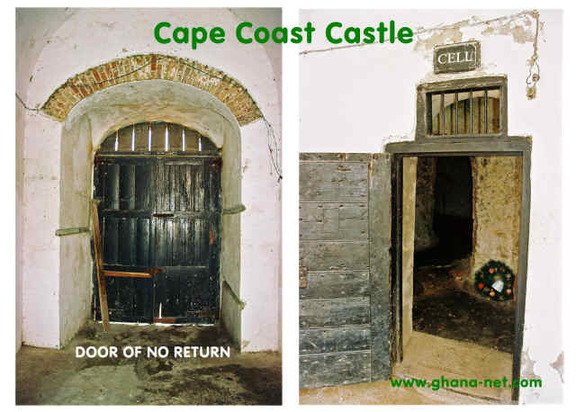
Cape Coast Castle — the Door of No Return and the female dungeon.
The oldest European building in sub-Saharan Africa, begun in 1482 after Diogo de Azambuja negotiated with Kwamina Ansa. Portuguese, then Dutch from 1637, then British. The dungeons, the Door of No Return, and the church the Dutch built directly above the holding cells.
Begun by the Swedes, taken by the Danes, then the Dutch, then the British — who made it the seat of the Gold Coast administration. The largest slave-holding dungeons on the coast, and the site most diaspora visitors come for.
Built by the Danes, and the seat of government of independent Ghana until 2013. Nkrumah worked here, and so did every leader after him — above a lower courtyard where more than three hundred enslaved people lie in unmarked ground. Access is restricted and the official opening times contradict each other. Telephone before travelling.
Portugal arrived first and left least — Elmina, the forts at Axim and at Shama at the mouth of
the Pra, and a small trading post at Accra that almost nobody knows about. The Dutch began at
Mouri in 1612, took Elmina in 1637 and spent the next two centuries holding the central coast
against everyone. Their forts are the best-built here, and several are still standing because
of it.
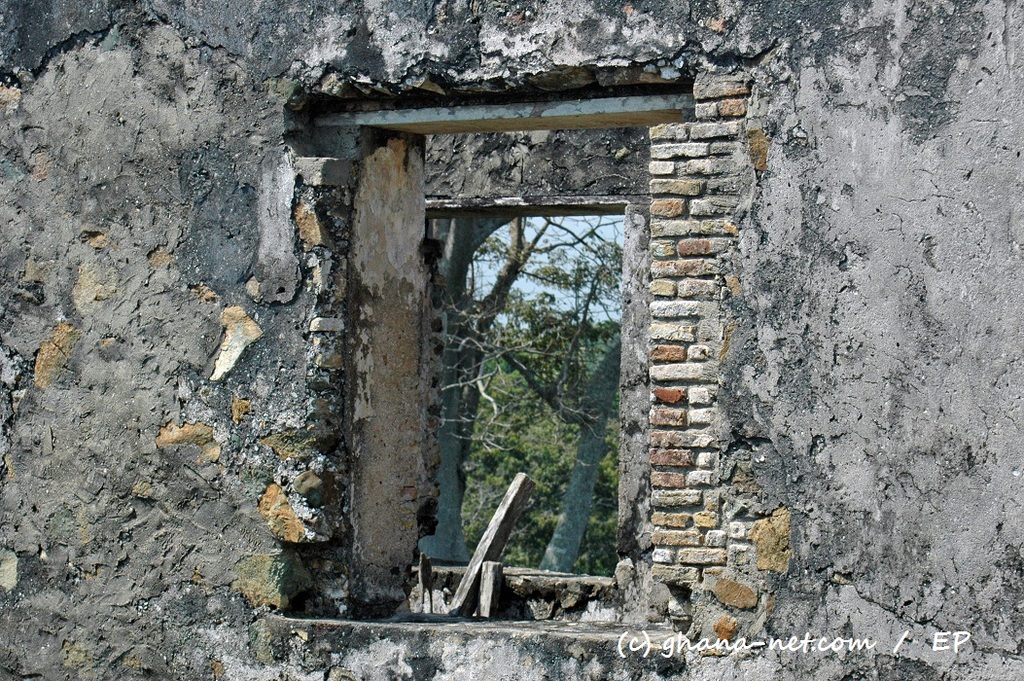
Fort Batenstein, Butre, Western Region — Dutch. An old wooden window frame.
The first Brazil Lane, Jamestown, Accra · Portuguese
The first European trading post in the Accra area — a small Portuguese fort that predates Osu Castle and everything else on this stretch of coast. Known today as Franklin Lodge or Franklin House, it stands on Brazil Lane, beside Brazil House. Most people walk past it in Jamestown without knowing what it is, and it is barely documented anywhere else online. Accra's European history starts here, not at Christiansborg.
Portugal's second fort on the Gold Coast, wedged onto a rock at the edge of Axim and built for the gold of the Ankobra. Taken by the Dutch in 1642 — Portugal's last foothold on this coast. The river that made it rich is now one of the worst hit by galamsey.
Ghana's third-oldest European fort, built by the Portuguese in the 1520s above the mouth of the Pra and rebuilt by the Dutch in 1640–43. Almost nobody visits. The climb is steep and there are no handrails, but the view from the top is one of the best on the western coast — over a sea that galamsey on the Pra has turned brown. The official information about it is years out of date; ours is from January 2026.
The first Dutch fort on the Gold Coast, built after a treaty with Asebu, and Dutch headquarters until Elmina fell in 1637. Every Dutch fort in Ghana goes back to this ruin in a fishing town east of Cape Coast.
On St Jago hill directly opposite Elmina Castle, built to stop anyone else doing what the Dutch had just done — taking Elmina from the high ground. The best view of the castle is from up here.
Two rival forts on one stretch of beach — the Dutch fort, and the more visible British one. The flashpoint of the Komenda Wars in the 1690s, a conflict in which local rulers, not the Europeans, largely determined who won. Nowhere shows how this coast actually worked more plainly.
The Dutch fort at Komenda — "fort of peace", which turned out to be the wrong name. The story of the Komenda Wars, of John Cabess and of the African rulers who decided who won.
Built by the English as Fort Kormantin, taken by the Dutch in 1665. The name Coromantee — used across the Caribbean for enslaved people shipped from this stretch of coast — comes from here.
Butre is where the Dutch signed a treaty with the Ahanta in 1656 that held until 1872 — one of the longest-standing agreements between a European power and an African state anywhere.
Fort Lijdzaamheid — the Dutch named it Patience because building it took so long. One of the better-preserved smaller forts, on a headland above a working fishing beach.
The Dutch fort above Sekondi harbour, built in the 1640s and later converted into a lighthouse — which is why it survives at all when so many others did not. It sits in a working port city rather than a heritage town, so almost nobody stops.
Most people — Ghanaians and Germans alike — have no idea that Brandenburg-Prussia held a
colony on this coast from 1683 to 1717, two centuries before Togo and Cameroon. It built two
forts on the Ahanta coast. One still stands.
Brandenburg's headquarters on Manfro Hill. When Prussia sold it to the Dutch in 1717, the Ahanta ruler John Conny refused to accept the sale — and held the fort against the Dutch for seven years.
The second German fort, named after the Great Elector's wife and taken by the Dutch from 1687 to 1698. Today little more than foundations in a fishing village near Cape Three Points.
The British arrived late and finished first — by 1872 they had bought or taken everything.
Their forts carry the second half of the story: the trade, its abolition, and the colonial
administration that followed.
One of the largest British forts on the coast. The Asante war that began in late 1806 reached here in June 1807: the garrison held the fort, but the Fante of the town, allies of the British, were slaughtered outside its walls. A major slave-trading post, and far less visited than it deserves. Fifty yards away stands Castle Brew, the "Little Fort".
The westernmost fort in Ghana, handed to the Dutch in 1868 and back to Britain in 1872 — now a museum of Nzema history, and the starting point for the Nzulezu stilt village.
Above the fishing harbour at Dixcove, and one of the strangest stories on this coast — leased to a British private individual in the 2000s, prompting a dispute about who can hold a World Heritage site.
Not a fort in the fighting sense — a lighthouse tower built on an older battery above Cape Coast, and still operating. Walk up for the view over the castle and the town.
A small watchtower on the hill behind Cape Coast, built to guard the castle's landward approach. Little visited, and the quietest viewpoint over the town.
The only one far from the sea, built after the British occupation of Kumasi — and besieged in 1900 during the War of the Golden Stool, when Yaa Asantewaa led the Asante against it. Now a military museum.
Denmark held the coast east of Accra for nearly two centuries and sold the lot to Britain
in 1850 — a reminder of how many European states were involved in this trade, including
several that have largely forgotten it. The Danish transatlantic trade carried at least
100,000 captives. Two of its forts are now being taken by the sea; one has already gone.
Fort Prinzenstein, Keta — what remains of the fort.
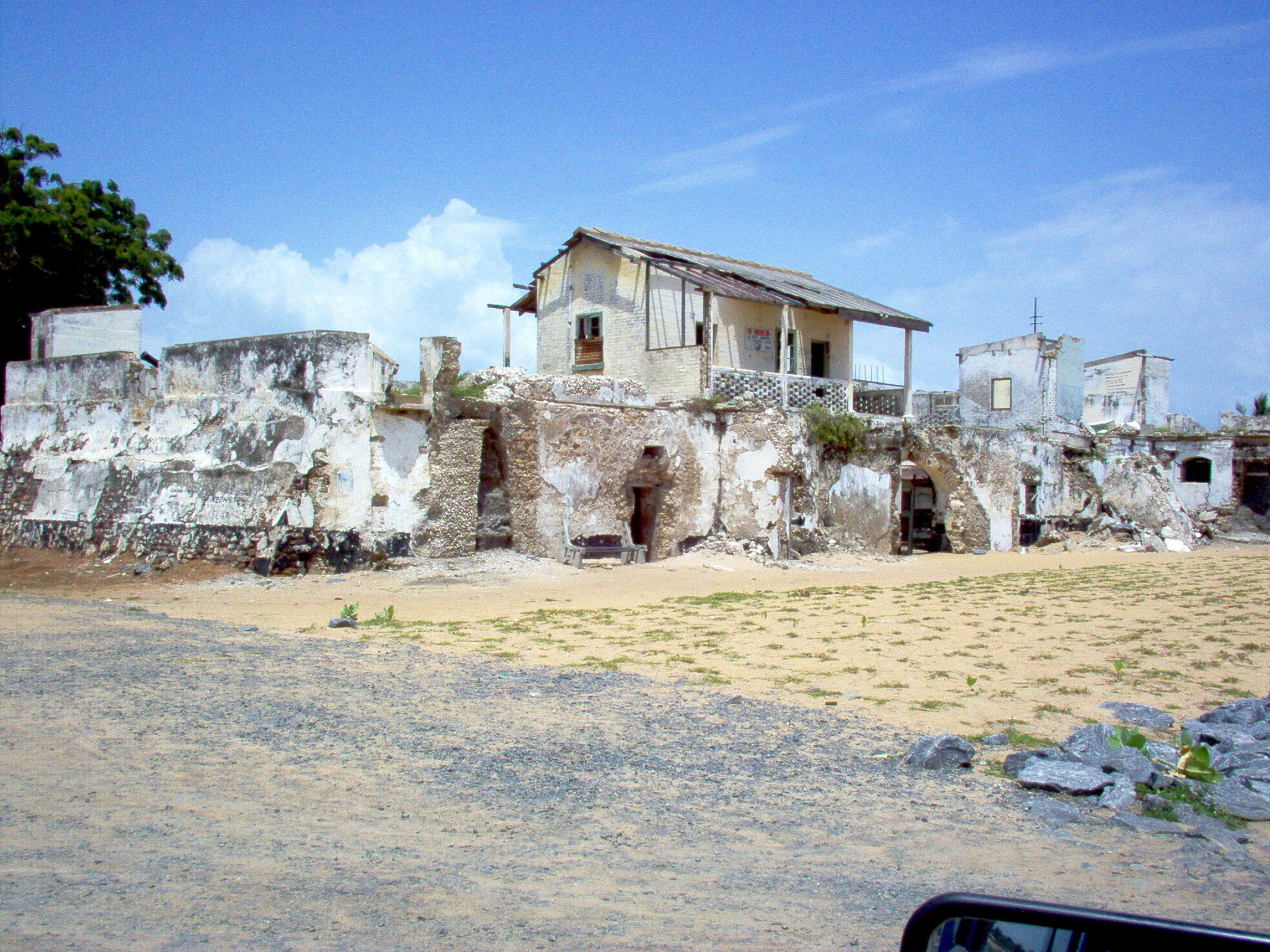
The easternmost fort, and the one the Atlantic is taking back — much of it has already gone to coastal erosion at Keta. What remains includes the dungeons. Go while there is something to see.
The Danish fort at the mouth of the Volta, bought by Britain in 1850 and since completely eroded away. What is left is what archaeologists salvaged before the waves finished the job.
The Danish "fort of peace", built for the slave trade. By 1835 one man was left to keep the flag flying; Britain took it over as a ruin in 1850. Today it is little more than part of an arched wall — the dungeons are probably buried beneath the ground.
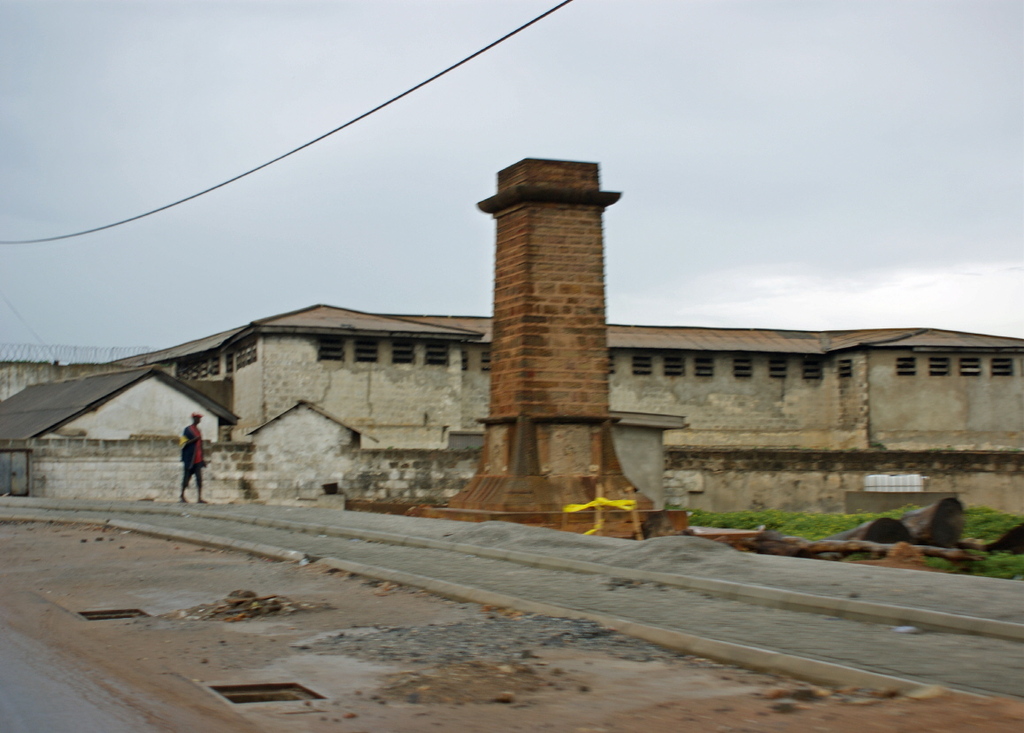
A Danish plantation fort at Teshie, part of Denmark's late attempt to grow crops on the Gold Coast rather than ship people from it. Largely in ruins and not looked after by the Museums and Monuments Board — people are living in parts of what is left. Largely unknown even in Accra, hard to reach without someone local, and you pass the ruins of a destroyed chief's palace on the way.
Denmark's fort on the hill above Cape Coast Castle, pawned to the English, sold in 1685 and renamed Fort Royal — then abandoned. Often listed twice, as if it were two forts.
Greater Accra has more forts than any other part of the coast and almost no fort tourism.
These get no visitors and, in some cases, no protection. One of them was run by an
African family rather than a European company — a part of this history the castle tours
generally leave out, and which belongs in the record.
A fortified slave-trading compound in Osu run not by a European company but by a Euro-African family — and built four to six years after Denmark abolished the trade in 1803. A documented tunnel runs from here to the dungeons of Osu Castle. In 1836 a Danish official wrote home that Richter held four hundred slaves. Until the 1960s there was much more to see; it was partly demolished under Nkrumah and by the people living there. The big stairs, the plastered front yard, the entrance gate and some walls remain. Ask the residents before taking photographs — they will ask for money, so negotiate.
The British answer to Dutch Ussher Fort a few hundred metres away. Later a prison — Nkrumah was held here. Jamestown around it is one of the most photographed neighbourhoods in Accra.
Dutch Fort Crèvecœur, later British, later a prison — and one where political detainees were held after independence as well as before it. That continuity is rarely discussed. Nkrumah's cell at Ussher, not James Fort, is where he ran the CPP from prison in 1950–51.
A small British fort on the eastern coast at Prampram, now largely ruined. Along with Prinzenstein at Keta, one of the sites this coast is quietly taking back — and worth photographing while there is something left to photograph.
Doing all five Accra forts in one go? We have written the route — order,
timings, what is open, what is locked and which one needs a local guide:
The Five Forts of Accra.
No tour operator offers it, which is precisely why it is worth doing.
Lost, buried or undocumented
Some forts on this coast were blown up, some are under the sand, and some are listed as
protected monuments by an authority that cannot say what they are. They belong in the record
as much as Elmina does.
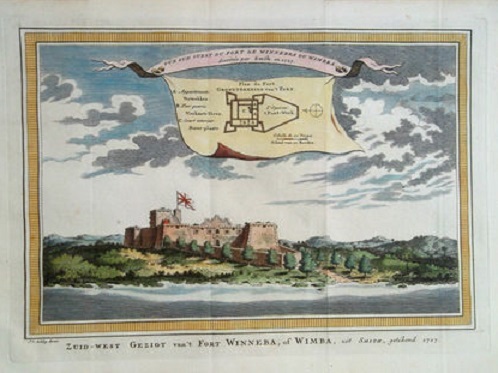
Winneba Fort in an old drawing. An English trading post from 1632, abandoned no later than
1644; a fort built in 1694; destroyed by the British in 1812.
In 1812 the Effutu killed the fort's commandant, Henry Meredith. The British answer was to blow up the fort and burn the town — which is why Winneba has no fort today.
Listed as a protected ruin in a single sentence, and the guides at Fort William could not tell us where it was. It stands fifty yards from them: Castle Brew, known in Fante as aban kakraba, the mansion and private slave-holding compound of the Irish trader Richard Brew, later extended by Brodie Cruickshank and George Kuntu Blankson.
A British ruin on one of Cape Coast's hills, almost certainly named after the governor killed by the Asante in 1824. The heritage authority says no documentation exists.
Know one we have missed? Around forty forts were built on this coast and
not all of them are recorded anywhere. If you know of a ruin, a foundation or a building
with a story attached, tell us — we would
rather document it than let it disappear unnoticed.
Where the people came from
The forts are the last stop, not the story. People held in these dungeons had already
walked hundreds of kilometres, through markets and camps that are still there and which
almost no visitor sees. If you go to the castles without seeing the inland sites, you are
reading the last chapter first.
The great market of the north, where people taken from across the savannah and beyond were bought and sold before the walk south. The wells where captives were washed before sale are still there.
A transit camp near the Burkina Faso border, established in 1704. The rock bowls carved for feeding are still in the ground, and so is the punishment rock. One of the most affecting sites in Ghana, and one of the least visited.
Nnonkonsuo — the Slave River — where captives were washed for the last time before being marched to Cape Coast and Elmina. Two returned ancestors are buried here. The obvious stop between the north and the coast, and the one most itineraries skip.
The honest version of the route. Salaga or Pikworo in the north, Assin Manso
in the middle, the castles at the coast. That is the actual direction of travel, and doing it
in that order changes what the dungeons mean when you finally reach them. Most tours run it
backwards or skip the first two entirely.
See also Who Sold Whom.
Visiting the forts
Guides are compulsory, and worth it
At Cape Coast and Elmina you cannot enter the dungeons unaccompanied, and you would not
want to. The guides are the experience — many have done this for decades. Fees differ
for Ghanaians and foreign visitors, and there is usually a separate camera charge. Tip
at the end.
Prepare for what this is
The dungeons are not an exhibit. People become distressed, particularly diaspora
visitors, and that is a normal response rather than an embarrassment. Allow a full
morning, schedule nothing demanding afterwards, and consider going with someone rather
than alone.
Photography
Permitted in most areas with a camera fee, but read the room. In the dungeons and at
the Door of No Return there will be people having a profound personal experience.
Photographing strangers in that moment is intrusion, not documentation.
Beyond the two big ones
The smaller forts often have no fixed hours and no staff. Ask in the town — someone
will have the key, and a small payment is customary. Wear proper shoes: several are
partly ruined, with unstable floors and no railings.
A route that works. Base at Cape Coast for two nights: the castle one
morning, Elmina and Coenraadsburg the next, Anomabo and Fort Amsterdam on the way in or
out. Add Kakum if you want a break
from it — and you probably will.
Check before you travel to any of them. Opening arrangements at Ghanaian
monuments change without notice, and in at least one case — Osu Castle — two different
government bodies publish different opening times. Ghana Museums and Monuments Board,
2 Barnes Road, Adabraka, Accra: +233 302 221633 or
+233 302 221635.
Guided castle tours
Cape Coast and Elmina day trips run from Accra and are worth a full day of anyone's
itinerary. If you are travelling from the diaspora and want the castles handled properly
— transport, timing, a guide who knows the material — booking ahead saves the whole day
from going wrong.
Bookings through this widget earn us a commission at no extra cost to you. We have no
arrangement with any individual operator and no operator has paid to appear on this page.
No tour we know of covers the smaller forts — for those you arrange your
own transport, which is part of why we document them here.