There are places in Ghana where the difference between being remembered and being properly remembered becomes difficult to ignore.
Asomdwe Park, beside Geese Park and close to Osu Castle in Accra, is one of them.
This is the final resting place of Professor John Evans Fiifi Atta Mills, Ghana's former President who died in office on 24 July 2012.
His grave is here.
The presidential memorial is here.
Official ceremonies are held here.
Government representatives come here.
Family members come here.
Political leaders come here.
And every year, wreaths are laid here to remember the man who served as President of Ghana.
But there is another question that matters to anyone travelling through Accra:
Can an ordinary visitor actually visit the place?
That is where the story becomes considerably less straightforward.
First, an important distinction.
Asomdwe Atta Mills Park and the neighbouring Geese Park are not the same place.
Geese Park is the recreational park next door, redeveloped and officially commissioned as the Accra Recreation and Leisure Park in January 2025. The official announcement specifically described it as connecting with the neighbouring Atta Mills Asomdwe Park.
Asomdwe Park has a completely different purpose.
It is a memorial and burial site.
This is where Professor Atta Mills was laid to rest after his death in 2012.
The two sites sit beside one another, but they should not be confused.
John Evans Fiifi Atta Mills served as President of Ghana from 2009 until his death in July 2012.
His death while still in office shocked the country.
He was subsequently buried at Asomdwe Park near Osu Castle, making the site an important part of Ghana's modern political history.
There is therefore a very simple reason why a serious Ghana travel guide should list Asomdwe Park:
A Ghanaian President is buried here.
For anyone interested in the country's political history, this is not an optional footnote.
It is part of the story of modern Ghana.
The current visitor situation also has a history.
Asomdwe Park has not always been maintained to the standard one might expect for the final resting place of a sitting president who died in office.
In 2019, the Daily Graphic reported concerns about the condition of the park and noted that the family had considered moving Professor Mills' remains because of the state of the site. At the time, some rehabilitation work had been carried out and the grounds had been cleaned.
The deterioration had become serious enough that reports described concerns about the condition of the tomb and the surrounding grounds.
That should have been an uncomfortable warning.
A presidential burial site should not need a crisis before attention is paid to it.
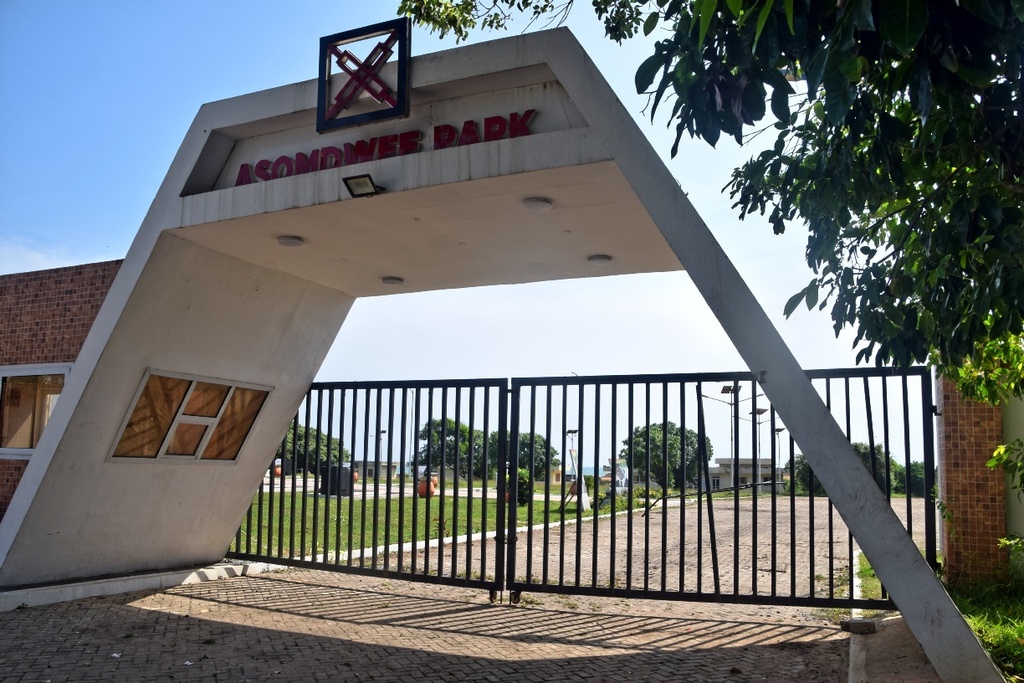
Asomdwee Park (c) Remo Kurka
In July 2022, on the tenth anniversary of Professor Mills' death, the government refurbished and commissioned Asomdwe Park.
A memorial and thanksgiving service was held at the site, and the refurbished park was inaugurated and consecrated. A new tombstone and statue were unveiled.
At the time, the refurbishment was presented as giving the late President a final resting place befitting his status.
That was a positive development.
But refurbishment and long-term visitor access are two different things.
A ceremony can restore a place for a day.
A functioning memorial requires attention afterwards as well.
The site has certainly not been forgotten when it comes to official remembrance.
In July 2023, the 11th anniversary of Professor Mills' death was marked at Asomdwee Park with a wreath-laying ceremony attended by Parliament, the Mills family, former President John Mahama and representatives of the National Democratic Congress and the John Evans Atta Mills Memorial Heritage.
The 12th anniversary was similarly marked at the graveside in 2024.
And on 24 July 2026, the 14th anniversary was again commemorated at Asomdwee Park. President John Dramani Mahama laid a wreath on behalf of the Republic, alongside representatives of Parliament, the Mills family, the NDC, the Memorial Heritage and other national institutions.
So the place is certainly remembered.
The annual ceremony proves that.
The question is whether the place is functioning as a properly accessible memorial for visitors throughout the rest of the year.
For the ordinary traveller, Asomdwe Park is not a normal museum.
There is no straightforward visitor experience comparable to walking into an established memorial attraction, paying an entrance fee if required, receiving information and being able to explore the site at your own pace.
Access is not something a visitor should simply assume.
In practice, the site can be difficult to enter as an ordinary, independent visitor.
And that is the point Ghana-Net wants to make clearly.
A memorial ceremony is not the same thing as public access.
A government delegation being able to enter does not mean that a tourist arriving on a Tuesday afternoon will receive the same welcome.
There is an irony here that is difficult to avoid.
A former President of Ghana lies in this park.
Every year, political leaders and dignitaries return to lay wreaths.
Memorial services are organised.
Speeches are made about his legacy.
His life and presidency are remembered.
Yet an ordinary traveller may struggle to experience the place as a visitor.
That is not a criticism of the late President.
It is not even principally a political criticism.
It is a question about how Ghana treats its own history.
If a country wants international visitors to understand its history, the physical places where that history happened — and where important people are buried — need to be accessible enough to be experienced.
Otherwise the history remains something that exists in official speeches rather than something the visitor can encounter.
Imagine a visitor interested in Ghana's presidents.
They have already visited Independence Square.
They have seen the Black Star.
They have visited the Parliament area.
They have travelled through Osu.
They know that Atta Mills, who died in office, is buried near Osu Castle.
Naturally, they want to see his grave.
What should they expect?
This is precisely where a normal tourism description can be misleading.
The visitor should not assume that because Asomdwe Park is an official memorial site, it operates as an ordinary tourist attraction.
It does not.
And Ghana-Net would rather tell you that before you arrive than leave you standing outside the entrance wondering what went wrong.
There is nevertheless a good reason to know where Asomdwe Park is.
It is close to Osu Castle and immediately beside Geese Park.
That makes the area an important concentration of Accra's history.
A visitor exploring the Osu coastline and the historic castle area can at least understand the significance of the site and its relationship with the surrounding landmarks.
Geese Park is the recreational space.
Asomdwe Park is the presidential memorial and burial site.
Osu Castle is the historic former seat of government and colonial-era fortification.
Three places.
Three different histories.
And three very different visitor experiences.
If you are already in the Osu Castle area, know that Asomdwe Park is there.
If you are interested in Ghana's political history, know that Professor Atta Mills is buried there.
But do not plan your day on the assumption that you can simply arrive and walk into a fully functioning public memorial.
The reality is more complicated.
Access can be informal and dependent on circumstances rather than a dependable visitor system.
That is an important distinction for independent travellers.
The ceremonies themselves are significant.
They demonstrate that the site remains important to the state, to Professor Mills' family and to political and civic organisations.
The 2026 anniversary ceremony, for example, again brought together the President, Parliament, the Mills family and other national representatives at the graveside.
There is nothing wrong with commemorating a former President.
Quite the opposite.
But there is an important question behind all those ceremonies:
What happens to the memorial site when the dignitaries have gone home?
That is the question a visitor guide should ask.
Asomdwe Park is an important place.
It contains the grave of a Ghanaian President who died in office.
It is part of the modern history of Ghana.
It has been refurbished.
It is used for official and family commemorations.
And it deserves respect.
But respect and accessibility are not the same thing.
For the traveller, the most important fact is simple:
Do not confuse an official memorial site with a normally functioning tourist attraction.
If you are nearby, it is worth knowing about.
If you are specifically interested in Atta Mills and Ghana's political history, it is unquestionably significant.
But do not assume that an ordinary visitor has the same access that officials and invited guests have during a memorial ceremony.
Location: Osu, Accra, beside Geese Park and near Osu Castle.
What it is: The memorial and burial site of former President John Evans Fiifi Atta Mills.
Historical importance: Professor Atta Mills served as President of Ghana from 2009 until his death in office on 24 July 2012. He was buried at Asomdwe Park.
Visitor access: Do not assume normal, unrestricted tourist access.
Memorial ceremonies: Annual commemorative and wreath-laying ceremonies continue to be held at the site, most recently in July 2026.
Ghana-Net advice: If visiting the area, ask locally about access rather than relying solely on the fact that the site is an official memorial.
There is something uncomfortable about a country that can gather its President, Parliament, family members and political representatives at the grave of a former President every year — yet does not make the same place straightforward for an ordinary visitor to experience.
The ceremonies are real.
The grave is real.
The history is real.
But for the independent traveller, access is another matter.
Ghana-Net does not believe that a travel guide should turn that reality into a glossy tourism description.
Professor Atta Mills deserves to be remembered.
His grave deserves dignity.
And if Ghana wants visitors to understand its history, they should also have a realistic opportunity to encounter it.
Until then, put Asomdwe Park on your map — but do not put it on your itinerary as though it were a normal, reliably open tourist attraction.
That is the honest answer.
