Ghana-Net.com · Accra · Osu · Ohene Djan Stadium
Ghana's national stadium, home of Hearts of Oak and the Black Stars, and the site of the worst football disaster in African history. On 9 May 2001, 127 people came here to watch a league match and did not go home. There are memorial statues at the front entrance. Almost no visitor to Accra knows why.
A Wednesday evening. Ghana Premier League. Accra Hearts of Oak against Asante Kotoko — the country's two biggest clubs, its oldest rivalry, and a full house at a stadium holding around forty thousand.
Kotoko led through a goal from Lawrence Adjei. Late in the match Hearts scored twice through Ishmael Addo to win 2–1.
With roughly five minutes remaining, some Kotoko supporters began tearing plastic seats from a stand and throwing them, with bottles, onto the pitch.
Riot police, stationed in anticipation of trouble, fired tear gas into the stands.
What followed took minutes. Spectators fled the gas toward the exits. Many of the exits were locked. The crowd compressed against them and could not disperse.
Most of those who died did so from compressive asphyxia — crushed upright in a crowd with nowhere to go. Some died of other injuries. Roughly fifty more were injured. The great majority of the dead were Asante Kotoko supporters. Several were women.
127 is the figure used in Ghana's annual commemorations, by the Ghana Football Association, and in the manslaughter charges subsequently brought. Some records, including Wikipedia, give 126. Early reporting on the night gave lower numbers as hospitals were still counting. We give both rather than choose.
It is the worst stadium disaster in African history, and the second-deadliest disaster in the history of association football anywhere — behind only the Estadio Nacional disaster in Lima in 1964.
There were reports that medical assistance withdrew from the scene, leaving unconscious people unattended. That detail appears in Ghanaian accounts of the night and has never been comfortably addressed.
President John Agyekum Kufuor declared three days of national mourning. The Ghana Premier League was suspended for a month.
A commission of inquiry was established under Justice Sam Okudzeto.
It found poor crowd control and inadequate security arrangements. It found that the police had overreacted, using tear gas and plastic bullets against a crowd inside an enclosed stadium. It accused them of carelessness and of dishonesty.
It recommended improved stadium safety, first aid stations and rapid response teams for emergencies.
On its recommendation, six police officers were charged with 127 counts of manslaughter.
Three years later, a seven-member jury returned verdicts of not guilty. All six were discharged. The prosecution had failed to prove its case; the court held that it could not be established that the gas caused the deaths, finding the stampede the likely cause, and that the officers had been duty-bound and acting lawfully in dispersing people destroying public property.
So the position is this. An official inquiry found the police overreacted and acted dishonestly. Charges were brought. Nobody was convicted. Twenty-five years on, no person has been held responsible for the deaths of 127 people, and no finding has ever been made as to who locked the exits.
We are not going to relitigate a criminal trial on a travel page. But a visitor standing at those statues should know that the memorial commemorates a disaster for which the legal record contains no answer.
What has been built since came from the football community rather than from the state.
There are memorial statues at the front entrance of the stadium. They are the reason to arrive on foot rather than be dropped at a gate, and most people who pass them have no idea what they mark. Stop for a minute before you go in.
The remembrance movement, led by former Asante Kotoko chairman Herbert Mensah. Street walks in Kumasi, wreath-layings, prayers in churches and mosques, and sustained support for the victims' families — including the 148 children left behind.
A commemoration is held at the stadium, bringing together the families, the two clubs, the Ghana Football Association and government. If you are in Accra on that date, it is open and it is the most affecting thing happening in the city.
Hearts of Oak against Asante Kotoko is no longer played at night. Not legislated, not announced with a ceremony — simply how it has been done since. It is the most concrete memorial the disaster produced.
Formally the Ohene Djan Stadium, named for Ohene Djan, the pioneering administrator who built Ghanaian football in the Nkrumah era — and still called the Accra Sports Stadium by almost everybody.
Ghanaian league football is cheap, loud, and one of the best things a visitor can do in Accra. It is also almost entirely absent from tour itineraries.
The stadium sits in the densest cluster of significant sites in Accra. Almost everything on this list is walkable or a very short ride.
A day built round here works well. Black Star Square and the Gate first thing, the stadium statues, Osu Castle, then Nkrumah Memorial Park, then Osu in the evening. Everything within a small radius, which in Accra traffic is worth more than any individual sight on the list.
Practical details last verified . The disaster occurred on Wednesday 9 May 2001 during a Ghana Premier League match between Accra Hearts of Oak and Asante Kotoko, which Hearts won 2–1. The death toll is given as 127 by the Ghana Football Association, in Ghana's annual commemorations and in the manslaughter charges brought, and as 126 in some records including Wikipedia; both are stated here. Deaths were primarily from compressive asphyxia following a stampede after police fired tear gas into the stands, with a number of exits reported locked. The commission of inquiry under Justice Sam Okudzeto found police overreaction, carelessness and dishonesty, and recommended charges; six police officers were charged with 127 counts of manslaughter and were acquitted approximately three years later by a seven-member jury, the prosecution having failed to prove its case. The officers are not named here as they were acquitted. President Kufuor declared three days of national mourning and the Premier League was suspended for one month. The stadium was renovated to FIFA standards in 2007. Fixtures, ticket arrangements and commemoration details change — confirm locally. All photography © Remo Kurka. Usage strictly by prior authorisation only.
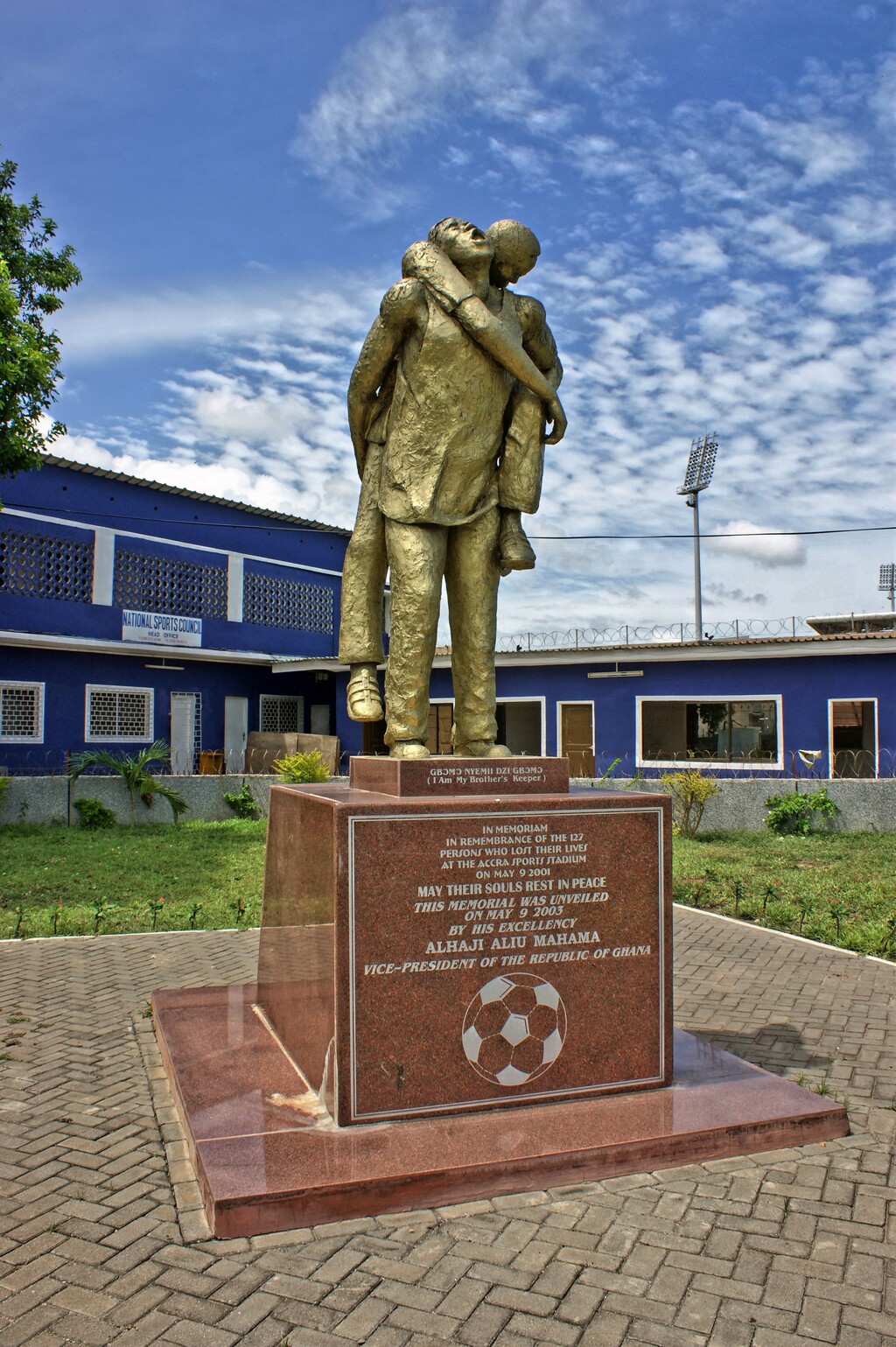
Memorial at Accra Sports Stadium
