There are not many places in Accra where you can step away from the traffic, concrete, walls and constant construction and still feel that you are inside a genuinely green landscape.
Achimota Forest is one of them.
Or, perhaps more accurately, it is one of the last places where that possibility still exists.
For visitors, Achimota Forest is interesting because it offers something very different from the usual Accra itinerary. There are no colonial forts here, no Independence Arch, no polished museum entrance and no carefully packaged heritage experience.
Instead, there is forest.
There is the old Accra Zoo.
There are trees, birds, wildlife facilities and the remnants of an urban green space that once occupied a much larger place in the life of Accra.
And there is another story which tourists should understand before visiting: the forest has been under enormous pressure from development and competing claims to land.
That story became particularly serious in 2022, when approximately 361.5 acres on the southern periphery of the reserve ceased to have forest-reserve status under Executive Instrument 144.
The government at the time insisted that Achimota Forest itself had not been sold and said the affected land was being returned to the Owoo family, identified as the pre-acquisition owners. The controversy nevertheless demonstrated just how vulnerable one of Accra's most important remaining green spaces had become.
Then, in June 2026, Cabinet approved the revocation of E.I. 144 and E.I. 234.
In July, the Minister for Lands and Natural Resources announced that Achimota Forest would regain its original status as a Forest Reserve.
That is good news.
But it is not the end of the story.
Achimota Forest was created as a green buffer for Accra and Achimota School.
The reserve dates back to the colonial period, and the forest became one of the city's most important surviving urban natural areas.
Today, its importance is much greater than its size might suggest.
Accra has expanded enormously.
Roads have multiplied.
Neighbourhoods have grown into one another.
Land values have risen.
Open land has become increasingly difficult to find.
And every time another green space disappears, the city becomes a little more concrete and a little less breathable.
This is why Achimota Forest should not be viewed simply as “a forest with a zoo.”
It is part of the environmental infrastructure of Accra.
It provides habitat for wildlife, shade and vegetation within a heavily built-up metropolitan area, and a rare opportunity for residents and visitors to experience something approaching an urban forest.
The Lands Minister described it in July 2026 as the “only last man standing forest cover in Accra,” stressing its importance as an ecological safety zone for the city and surrounding areas.
That may sound dramatic.
Standing in the middle of Accra, however, it is not difficult to understand the point.
The connection between Achimota Forest and Accra Zoo is one of the most interesting parts of the story.
The Wildlife Division of Ghana's Forestry Commission administers Ghana's two principal zoos, including the Accra Zoo, and the Accra Zoological Gardens are located inside Achimota Forest.
The zoo is therefore not an unrelated attraction placed next to the forest.
It is part of the history of the place.
The Accra Zoo became associated with the forest when animals were moved there as the city developed. Over the years the site became known for its wildlife facilities and for the conservation work carried out there.
It is also important to understand that this is not simply an old-fashioned collection of animals for visitors to look at.
The Wildlife Division and conservation organisations have used the site for wildlife rescue and breeding work.
West African Primate Conservation Action, for example, established an Endangered Primate Breeding Centre at Accra Zoo in 2005 and has worked with the Wildlife Division on the care and breeding of threatened primates, including the white-naped mangabey and the critically endangered Roloway monkey.
That gives the old zoo a significance that goes well beyond nostalgia.
This is where visitors should manage their expectations.
Achimota Forest and Accra Zoo are sometimes presented online as though they were a conventional wildlife attraction comparable to a large modern zoo or safari park.
They are not.
The site is much more modest and much more closely connected to Ghana's wildlife-conservation system.
For a traveller interested in Ghana's natural history, that is actually part of its appeal.
This is not a manufactured safari experience.
It is a piece of Accra's wildlife history inside one of the city's remaining forested areas.
The Wildlife Division continues to have responsibility for the Accra Zoo, while conservation organisations have been involved in primate welfare, rescue and breeding programmes.
So the visitor should come here with curiosity rather than expectations of a major international zoo.
The real attraction is the combination:
forest + wildlife history + conservation + the remains of one of Accra's best-known zoological sites.
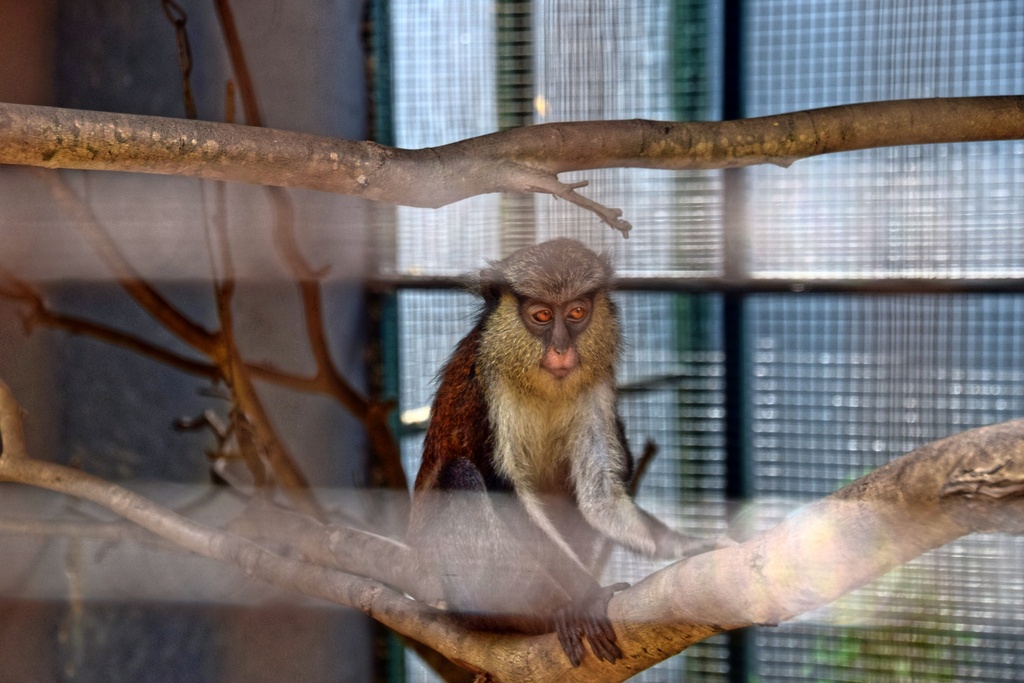
This monkey should be at Accra Zoo Achimota (c) Remo Kurka
This is the part that should not be hidden behind tourism language.
Achimota Forest has been under pressure from development and encroachment for years.
In February 2026, the Forestry Commission's Forest Services Division inspected sections of the forest boundary along the Legon–GIMPA bypass.
Officials reported encroachment, rubbish dumping by surrounding communities and ornamental plant sellers operating along the boundary.
They also reported rubbish being dumped around a nearby stream, with consequences for the ecosystem.
In other words, the problem is not theoretical.
The forest is being pressured at its edges.
And this is where the argument about Accra's green spaces becomes bigger than Achimota itself.
A forest does not suddenly disappear on the day somebody cuts down the last tree.
It disappears piece by piece.
A boundary is moved.
A road is widened.
A parcel is released.
A wall appears.
A new building arrives.
Rubbish accumulates.
A few more trees are removed.
Another access road is created.
Eventually, what was once a continuous ecological space becomes a collection of isolated green patches.
For a city like Accra, that is a serious loss.
The Achimota Forest controversy became international news in 2022.
Executive Instrument 144 removed approximately 361.5 acres from the protected forest-reserve classification.
The government rejected claims that it was selling the forest.
According to the government's explanation, the land concerned was peripheral land associated with the Owoo family, who had been seeking the return of land acquired by the state decades earlier. Parts had already been granted to the family in 2013, and E.I. 144 formalised the change in forest-reserve status.
The controversy became particularly powerful because of what the land represented to ordinary people.
For many residents of Accra, the distinction between “forest reserve,” “released land,” “returned land,” “private land” and “land available for development” was less important than the physical result.
Once green land is opened to development, the public generally does not get it back.
That was why the issue resonated so strongly.
The concern was not merely about paperwork.
It was about whether a rapidly expanding capital city could continue to afford to lose its remaining green areas.
There is an important new chapter.
On June 24, 2026, Cabinet approved the revocation of E.I. 144 as amended by E.I. 234.
The decision was announced publicly in July.
The stated result is the restoration of Achimota Forest to its original Forest Reserve status.
The government presented this as a major environmental-protection decision and as recognition of the forest's importance to Accra.
For Achimota, this is significant.
It means the legal story has moved in the opposite direction from the one that alarmed environmentalists and many Accra residents four years earlier.
But legal protection is only one part of conservation.
A forest still needs boundaries.
It needs enforcement.
It needs maintenance.
It needs protection against dumping and encroachment.
And, perhaps most importantly, it needs a public that understands why the forest is worth protecting.
There is an uncomfortable question behind Achimota Forest.
Who is a city for?
Only the people who own land in it?
Only developers?
Only people who can afford houses with private gardens?
Or also the ordinary resident who needs somewhere to walk, breathe, see trees, hear birds and escape the concrete for an hour?
That question is particularly important in Accra.
The city is growing, but green space cannot be manufactured as easily as another apartment block.
A new building can be constructed in a few months.
A mature forest cannot.
This is why Achimota Forest deserves to be discussed not simply as an environmental issue but as a public-space issue.
The forest is part of the city's common inheritance.
And if Accra loses it, future generations cannot simply buy another one.
There is also an opportunity here.
Protecting Achimota Forest does not mean putting a fence around it and preventing people from enjoying it.
Quite the opposite.
A properly managed urban forest could become one of Accra's most attractive nature-based tourism experiences.
Imagine a place where visitors could walk safely through designated forest trails, learn about Ghana's native trees, see birds, understand the history of the forest, visit appropriate wildlife and conservation facilities, and learn what happens when an African capital loses its natural spaces.
That would be tourism with a purpose.
The forest does not need to become another artificial theme park.
Its greatest attraction is precisely that it is real.
Achimota Forest is best approached as a nature and heritage experience rather than a polished sightseeing attraction.
Do not expect Kakum.
Do not expect a major safari park.
And do not expect a perfectly packaged tourist site where every path, building and facility has been designed around international visitors.
Instead, expect a fragment of the older green Accra.
The forest itself is the main attraction.
The zoo and wildlife facilities add another layer.
The history of the land adds another.
And the current struggle to preserve the forest makes the place particularly relevant.
For travellers interested in environmental issues, urban history, Ghanaian wildlife or the changing face of Accra, this is much more interesting than it might initially appear.
A foreign visitor might reasonably ask why a dispute over urban land should matter to someone spending only a few days in Ghana.
The answer is simple.
Tourism is not only about monuments.
It is also about understanding the places we visit.
Accra is often presented through beaches, nightlife, restaurants, markets, Independence Square, museums and historical monuments.
Those are all important.
But the story of Accra is also the story of what happens when a city grows.
Achimota Forest allows the visitor to see that story physically.
Here, the question is no longer theoretical.
You can see the forest.
You can see the city around it.
And you can understand just how much pressure exists between the two.
If you are interested in Achimota Forest, do not treat it as a quick photo stop.
Its value is in understanding the whole area.
The forest, the zoo, the wildlife-conservation history and the surrounding development all belong to the same story.
Come with realistic expectations about facilities and access.
And check the local situation before travelling specifically to visit any particular zoo or wildlife facility.
The Accra Zoo is part of the Forestry Commission's wildlife system, but this is not the kind of attraction where a traveller should assume that an old internet description automatically reflects the current visitor experience.
If you can visit responsibly, support conservation work and avoid treating the forest as an empty piece of land waiting for development.
It is not empty.
It is one of the things that makes Accra livable.
Achimota Forest is important even if you never see a single large animal.
It is important because it is forest.
It is important because Accra has so little of it left.
It is important because the Accra Zoo and wildlife-conservation history are tied to the site.
It is important because the forest has repeatedly come under pressure from development and competing claims to land.
And it is important because the latest political decision gives Ghana an opportunity to protect what remains.
The restoration of its reserve status in 2026 is encouraging.
But nobody should confuse a legal decision with the end of the battle.
The Forestry Commission was still documenting encroachment and environmental pressure on the boundaries earlier in 2026.
The real test will therefore be what happens next.
Will Accra protect its forest?
Will it make the place accessible and useful to the public without destroying it?
Can the old zoo and conservation facilities become part of a better nature-tourism experience?
Can development happen without consuming every remaining piece of green space?
These are not questions only for environmentalists.
They are questions for everybody who lives in, visits or cares about Accra.
Because once the green spaces are gone, they are extraordinarily difficult to bring back.
Location: Achimota, Accra, within the Achimota Forest area.
What it is: One of Accra's principal remaining urban forest areas, with the Accra Zoo and wildlife-conservation facilities associated with the site.
Why it matters: Forest habitat, urban ecology, wildlife conservation and the history of Accra's green belt.
The land controversy: In 2022, approximately 361.5 acres on the southern periphery ceased to be classified as forest reserve under E.I. 144. The government said the land was being returned to the Owoo family rather than sold.
Current legal position: In June 2026, Cabinet approved revocation of E.I. 144 as amended by E.I. 234, restoring the forest's original reserve status.
Reality check: Boundary encroachment, dumping and other pressures remain documented problems.
Best for: Nature lovers, environmentally conscious travellers, photographers, birdwatchers, families and anyone interested in the changing face of Accra.
Achimota Forest is not merely a piece of undeveloped land in the middle of Accra.
It is part of the city's history.
It is part of its ecology.
It is part of its remaining wildlife story.
And, increasingly, it is part of the argument about what kind of city Accra wants to become.
The government has now restored its protected status.
That gives the forest another chance.
What happens to it after that is up to more than government.
It is up to the people of Accra — and to whether the city decides that green space is something to be protected for everyone, rather than simply another piece of land that eventually disappears behind a wall.
3 girls selling fruits and food at the road side. (c) Strictly by Remo Kurka (photography)
